
The short answer
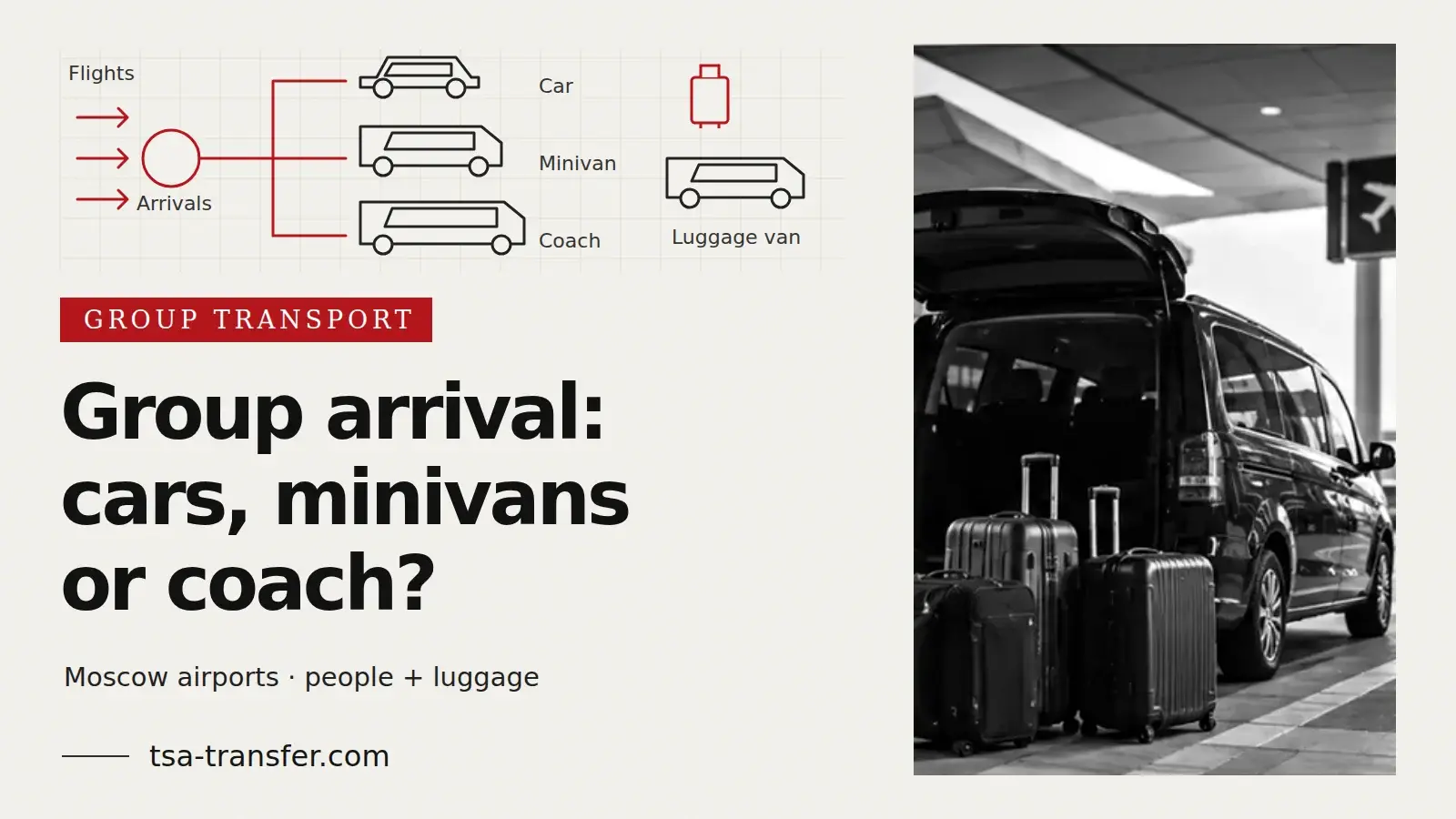
Choose transport for a group by two counts, not one: how many people are travelling and what luggage they actually carry. Seats and luggage space are different limits, and the luggage limit is usually reached first. Then check two more things: whether everyone lands on the same flight and goes to the same address, and whether a large vehicle can stop at that address. A group of 15 on one flight going to one hotel may suit a coach. The same 15 arriving on three flights and staying in two hotels usually works better as several cars or minivans.
This guide is about choosing vehicles. For a safe arrival at SVO, DME, VKO or ZIA (taxis, meeting points, what to send when booking), see Moscow Airport Transfer Without Surprises. For a full delegation plan with guest lists, coordinators and transport flows, see Moscow Delegation Arrivals: A Ground Transport Checklist.
Start with two counts: people and bags
Before you ask for a quote, write down:
- People. The total number, and who must travel separately (a senior guest, a speaker with an early meeting, someone going to a different hotel).
- Bags by type. Small cabin bags, large checked suitcases, extra-large hard cases, and anything unusual: bike boxes, skis, golf bags, camera or sound equipment, exhibition samples, folded wheelchairs or pushchairs.
"Four pieces of luggage" can mean four identical cabin bags, or three hard extra-large cases plus a soft holdall. Those are different vehicle decisions. Two bike boxes are only two pieces, but each can be almost as long as a person. The most reliable way to describe luggage is a single photo of all the bags standing in a row, plus the dimensions of anything non-standard.
TSA's planning categories, from the source guide linked in the next section, are not any airline's rules: small is a cabin bag or compact case up to about 55 cm on its longest side; large is a regular checked suitcase of about 65–75 cm; extra-large is over 75 cm, deeper than usual or noticeably expanded.
The vehicle ladder: TSA planning guidelines
The table shows the guidelines TSA uses when planning an airport pickup. They are not manufacturer figures and not a guarantee for any particular car: seat layouts, luggage areas and fittings vary between vehicles, so the actual vehicle is confirmed for each booking. Source: TSA's luggage table in How Much Luggage Fits in a Car with a Driver (in Russian).
| Vehicle type | People we plan for | Luggage we plan for | Notes |
|---|---|---|---|
| Business-class sedan | 1–3 | 2 large + 2 small | Five seats on paper, but a full car leaves no room for airport luggage |
| Premium sedan | 1–2 | 2 large + 1–2 small | A higher class does not mean a bigger boot |
| Premium SUV | 3–4, third row folded | 4 large + 2 small | Using the third row for people leaves little room for bags |
| Minivan (for example, Mercedes-Benz V-Class) | Up to 5 in the rear + 1 beside the driver | Example load: 3 extra-large below + 4 small on top | With 6 passengers, agree in advance who sits in front and send a luggage photo |
| Passenger Sprinter minibus used in TSA planning (Mercedes-Benz Sprinter) | 18–20 seats | Luggage for no more than 12 passengers | TSA's rule for this passenger Sprinter; another minibus is assessed by its actual luggage area |
| Coach | Larger groups, by the confirmed model | Only in confirmed luggage holds | Confirm the model and its holds before booking |
| Separate luggage vehicle | — | Bags, equipment, samples | Passengers travel in their own cars or minivans |
Bags are not planned in the aisle or on passengers' laps. If the luggage does not fit in the luggage area, the plan changes: a second vehicle or a separate luggage car.
The classic mistake: "20 seats means 20 suitcases"
A request for "one minibus for 18 people" is common. In TSA's planning, the passenger Sprinter with 18–20 seats takes luggage for no more than 12 passengers. Eighteen people with checked suitcases will not fit in one such Sprinter with their bags. Another minibus model is assessed by its actual luggage area, not by its seat count.
Typical ways to solve it:
- two minibuses, each loaded within its luggage limit;
- one minibus for people plus a separate luggage vehicle;
- several minivans, if the group splits by hotel or arrival time;
- a coach, if its holds are confirmed and it can stop at the destination.
Which option fits depends on the counts, the flights and the addresses, so treat this as a list of options to discuss, not a fixed rule.
Illustrative scenarios
These are typical starting points for discussion, not quotes and not fixed capacity. Each one is confirmed only after the luggage photo and the actual vehicle are checked.
- 2–4 senior guests, one large suitcase each. One or two sedans. Two separate cars help when guests go to different hotels or have different schedules.
- 5–6 people with suitcases. A minivan may work, but send the luggage photo first. With several extra-large cases, the answer may be a minivan plus a sedan, or a luggage car.
- 7–12 people with ordinary suitcases. A passenger Sprinter may work within its TSA luggage limit of 12 passengers; the luggage photo still decides, because extra-large or non-standard items take more room.
- 13–20 people with luggage. Not one passenger Sprinter: in TSA's planning it takes luggage for no more than 12 passengers. Two Sprinters, several minivans, or a coach with confirmed holds, with a luggage car if needed. Another minibus is assessed by its actual luggage area.
- A large group on one flight, going to one address. A coach makes sense if everyone travels together, the holds are confirmed and the coach can stop at the hotel or venue.
- Bike boxes, skis, equipment or samples. Count these as non-standard from the start. A separate luggage vehicle often solves it better than "a bigger bus".
One coach or several smaller vehicles?
A single coach is efficient when:
- the whole group lands on the same flight at the same airport;
- everyone goes to one address;
- the luggage holds are confirmed for the actual luggage;
- the coach can legally stop and load at that address.
Several cars or minivans are usually better when:
- people arrive on different flights, or at different Moscow airports;
- the group stays in more than one hotel;
- senior guests need to travel separately;
- one delayed flight should not hold the whole group at the airport;
- return trips start at different times;
- the hotel or venue is in central Moscow, where a coach cannot always stop at the entrance.
On the last point: tour coaches in central Moscow use designated stopping and parking places. Before choosing a coach, ask the hotel or venue where a coach can drop the group off, and confirm it with the transport provider.
The separate luggage vehicle
When a group carries a lot of equipment, a separate vehicle for luggage is a normal solution, not a sign that something went wrong. TSA uses it for delegations, sports teams, film crews and exhibition samples. Bags and equipment are loaded and secured in a spacious vehicle, and passengers travel in the class you chose. Agree in advance who checks that every item is loaded and who signs it off at the destination.
Several flights, one group
If people arrive in waves, plan the pickups by flight, not by group size. Send each flight number with its date rather than a copied arrival time: the transport team monitors the flight and adjusts the meeting. Decide in advance whether early arrivals wait for the next flight or leave straight away.
What to send when you request group transport
- Number of passengers, and who travels separately.
- Luggage by type: small, large, extra-large, non-standard; one photo of all the bags in a row.
- Dimensions of bike boxes, skis, equipment, samples, wheelchairs or pushchairs.
- For each wave of arrivals: the date, flight number, airport and terminal.
- For each return transfer, if needed: the date, pickup address and departure flight number.
- Destination addresses, and whether a large vehicle can stop there.
- Language needs: English-speaking support and an English-speaking driver are separate roles, so confirm both if both matter.
- The contact person on your side who approves changes.
How TSA Transfer handles group arrivals
TSA Transfer arranges business and premium-class cars, minivans, minibuses and coaches for airport arrivals in Moscow. The vehicle plan is built from your counts and the luggage photo; the actual vehicle is confirmed for the booking, and TSA sends a photo of it during confirmation. Meet-and-greet with a name sign is available. English-speaking support coordinates the booking, and an English-speaking driver can be requested in advance.
Foreign-issued Visa and Mastercard cards do not work in Russia. For a confirmed booking, TSA can send a secure online-payment link; whether the payment is authorised depends on the card's issuing bank. See How to Pay in Russia as a Foreign Visitor.
The quote depends on the vehicles, route and timing, and is prepared for your request.
Frequently asked questions
Can 18 people with suitcases travel in one Sprinter? Not in our planning. TSA's passenger Sprinter with 18–20 seats takes luggage for no more than 12 passengers. For 18 people with checked bags, plan two Sprinters, a Sprinter plus a luggage vehicle, or a coach with confirmed holds. Another minibus is assessed by its actual luggage area.
Can a coach take the group straight to a hotel in central Moscow? Sometimes. Coaches in the centre use designated stopping and parking places. Check with the hotel where a coach can stop, and confirm it with the transport provider before choosing one large vehicle.
Our group arrives on different flights. Should we book one big vehicle? Usually not. Plan pickups by flight. One large vehicle waiting for several flights keeps early arrivals at the airport and makes the whole group depend on the latest flight.
What about bike boxes, skis or equipment cases? Send their dimensions and a photo with the request. They often decide the plan: a separate luggage vehicle is common for sports teams and crews.
How do we know which vehicle will come? The vehicle type is agreed from your counts, and the actual vehicle is confirmed for the booking with a photo. Do not rely on a specific make or model unless it has been confirmed for your request.
Request a group transport plan
Send the number of people, the luggage photo, the date and flight number of each arrival, the dates of any return transfers, and the addresses. Message TSA Transfer on Telegram at @tsa_transfer or email tsa-transfer@mail.ru. Airport services are described on the Moscow airport transfer page; for larger groups see Delegation Transport in Moscow.