
The short answer
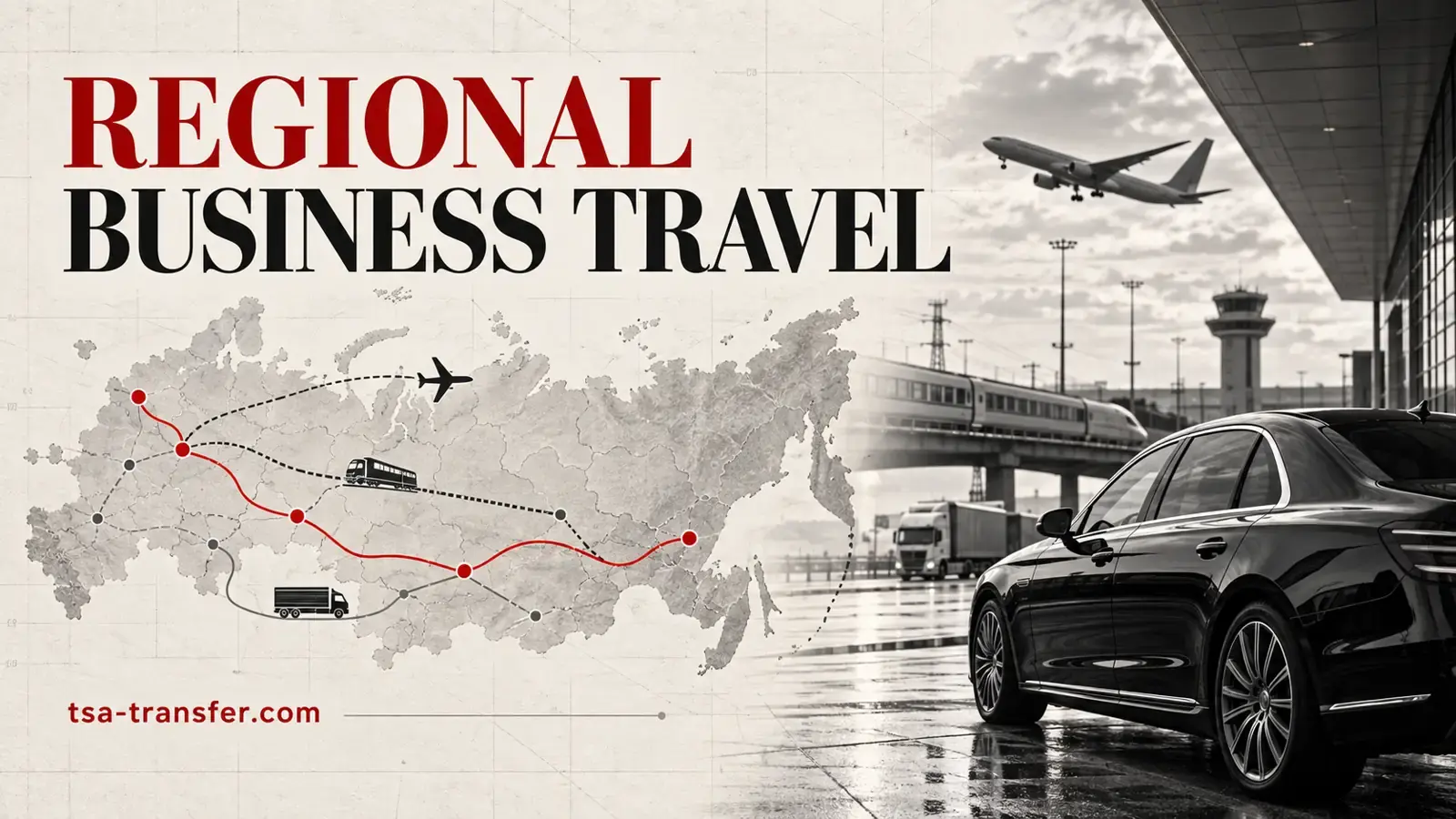
Compare the entire door-to-door movement, not the timetable alone. A flight can suit long distances, rail can connect central stations, and a car with driver can work for several nearby cities, industrial sites or routes with equipment. Choose the mode after the meetings, luggage, access times and next fixed departure are known.
Start with the business outcome
The transport plan exists to protect meetings, site access and passenger readiness. List the fixed points before comparing modes:
- city and exact address;
- required arrival time;
- duration of the meeting or visit;
- next destination;
- travellers and luggage;
- equipment or samples;
- whether work must continue during the movement;
- latest acceptable return.
A cheaper ticket can create a more expensive programme if it adds two airport transfers, an overnight or a missed meeting.
Compare door-to-door time
| Component | Flight | Train | Car with driver |
|---|---|---|---|
| Start | Transfer to airport | Transfer to station | Pickup at agreed address |
| Formalities | Check-in and airport process | Station and boarding process | Vehicle loading and departure |
| Main movement | Flight | Rail journey | Road journey |
| Arrival | Baggage and transfer | Station pickup | Direct arrival at destination |
| Flexibility | Tied to flight | Tied to train | Stops and route can be agreed |
| Best use | Long distance and suitable schedule | Strong city-to-city rail connection | Multiple stops or regional sites |
Use actual tickets, terminals, stations and addresses. A generic comparison cannot decide a real itinerary.
When a flight is practical
A flight is often the starting point for distant regional travel. The ground plan must still cover airport pickup, luggage, the first meeting and the return flight.
Check:
- Which airport and terminal are used.
- When the passenger must arrive for departure.
- Whether checked luggage or equipment is carried.
- How far the destination is from the airport.
- What happens if the flight changes.
The driver should receive the flight number, not only an estimated arrival time.
When rail is practical
Rail can work well when the timetable and city-centre stations fit the meeting day. It may also allow passengers to work during the journey.
The transport request should include the exact station, train, carriage when known, luggage and meeting point. Build the first appointment around the time needed to leave the train, meet the driver and reach the address.
For a Moscow and Saint Petersburg plan, see the station pickup and business-day guide.
When a car with driver is practical
A car can be useful when the route includes several towns, a plant outside the city, equipment, flexible stops or a destination poorly connected to the arrival hub.
It is not automatically the right solution for every distance. The plan must account for:
- safe driver hours;
- rest and overnight requirements;
- road conditions and seasonal restrictions;
- empty return or repositioning;
- parking and tolls;
- luggage and vehicle capacity.
For a long route, a second driver, overnight stop or combination with rail or air may be more realistic.
Consider a mixed itinerary
Many regional business programmes work best as a combination:
- flight to a regional airport, then car to an industrial site;
- train between major cities, with local vehicles at each end;
- car for a cluster of nearby meetings, then flight home;
- separate luggage or equipment movement when required.
Use one master itinerary so every handover has an owner, current arrival information and a contact.
Plan handovers between providers and cities
At each handover, record:
| Handover | Required information |
|---|---|
| Flight to local car | Flight, terminal, luggage, meeting method |
| Train to local car | Train, station, carriage and meeting point |
| Car to flight | Terminal, required arrival and luggage |
| City A driver to City B driver | Current arrival, passenger contact and next address |
The traveller should not have to reconstruct the programme from separate messages.
Protect the next fixed departure
Regional visits often run late because a meeting or site tour expands. Put the departure decision point in the schedule. The authorised contact should know when an optional stop must be removed or a meeting must end.
Do not assume that a driver can recover lost time by driving faster. Schedule pressure is solved by changing the programme, not by compromising safety.
Luggage and equipment can decide the mode
Samples, exhibition cases, protective clothing and technical equipment may change the vehicle and ticket plan. Confirm dimensions, weight and any transport restrictions with the relevant carrier and host.
The passenger vehicle should not be assumed to accept hazardous, dirty or oversized equipment. A separate logistics solution may be required.
Quotation and documents
Compare the full cost: tickets, local transfers, driver time, waiting, overnight, parking, tolls and possible changes. The transport quotation should show what is included and how extras are approved.
For a foreign company, confirm the contracting party, invoice, VAT presentation, payment method and completion document before the first service.
Regional trip checklist
- all cities and exact addresses;
- required meeting and gate-arrival times;
- flights or trains under consideration;
- passenger and luggage count;
- equipment and special items;
- local vehicles at every arrival point;
- safe road and driver plan;
- hotel and overnight requirements;
- handover contacts;
- next fixed departure;
- authorised change approver;
- billing and service documents.
Frequently asked questions
Is a car with driver better than a flight for regional travel?
Not automatically. Compare door-to-door time, distance, meetings, luggage, driver hours and the available flight schedule.
Can one TSA request cover several Russian cities?
Yes. Local vehicles and selected intercity sections can be coordinated in one itinerary, subject to confirmation.
Can the same driver continue through the whole route?
It depends on distance, schedule, rest and operational feasibility. The safe driver plan is confirmed with the route.
Can equipment travel with the passengers?
Only after its size, weight and safety requirements are confirmed. Some items require a separate solution.