
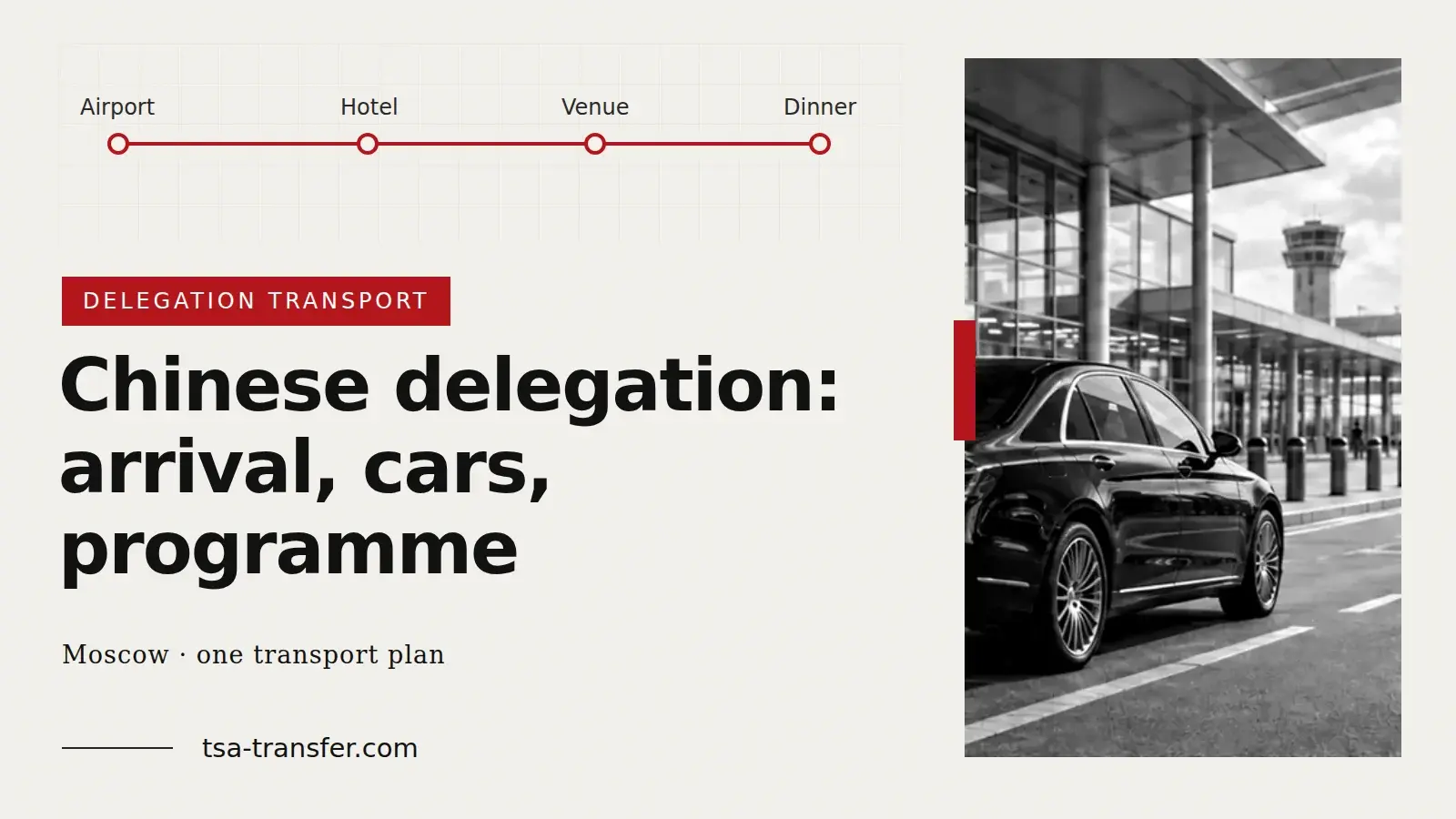
A delegation arriving from China rarely travels as one unit for the whole visit. The chair may go directly to a bilateral meeting while colleagues check in, and samples may need a different vehicle. The assistant's job is to turn those movements into a confirmed programme before anyone lands.
Start with the delegation protocol
Send the host's draft schedule, arrival flights and one contact authorised to approve changes. Identify the head of delegation, accompanying staff, interpreters and hosts; say who should travel together, who needs a separate car and whether arrival order matters. For a multi-car arrival, ask whether one car leads, where the other cars wait and whether the principal should arrive first; agree the sequence with the host rather than assuming one protocol fits every delegation. Provide passenger and luggage counts for each movement, including samples and the interpreter's seat. Share only the details a driver needs for their assignment; keep the full delegation list with the coordinator.
Ask the guests' office what language each guest can use operationally. An English-speaking driver can be requested and confirmed for the booking; an interpreter for Chinese-language negotiations or site visits is a separate requirement. A Chinese-speaking driver should never be assumed available. If private meetings or an escort are required, describe the protocol and ask TSA to check a separate arrangement; neither confidentiality arrangements nor security personnel are automatic.
Design the fleet around movements, not titles
List each flight, hotel, venue, meeting and fixed departure in one movement sheet. A separate executive car may suit the principal; a minivan may suit staff travelling together; bulky samples may require a cargo solution. Confirm vehicle class, actual capacity, luggage fit, driver language and working hours for the particular dates. A reserve vehicle is an option to request and price, not a guaranteed part of every booking.
For each day, place immovable meetings and access windows first. Work backwards to hotel departure, group-ready time and airport arrival, leaving a realistic margin for traffic and venue checks. Confirm who arranges passes and the permitted drop-off point with the host or organiser; a car booking does not grant restricted access. A separate city visit, museum or private guide can be considered around the business programme, subject to availability, venue rules and a separate agreement.
Make the first airport meeting work offline
For every arrival, agree a terminal, a precise meeting point, sign text in the spelling the guest recognises, and a fallback point and trigger if the parties miss each other. Send flight numbers and the destination address before departure. Foreign mobile data or messaging may not work immediately; give the guest the driver's and coordination contact details offline and nominate a host-side contact who can take a regular call. Confirm waiting and delay terms in writing, especially for staggered flights. See our arrival checklist.
Confirm the order and manage changes
Ask TSA for a written movement plan showing assigned vehicle classes, pickups, communication channel, waiting terms and the person who approves extra stops, hours or vehicles. The coordinator relays approved revisions to drivers; a passenger request that affects another vehicle is checked against the entire movement sheet. Reconfirm the next day's departures after programme changes rather than relying on yesterday's schedule.
For a company booking, agree the contracting party, invoice and service documents separately. Foreign-issued Visa and Mastercard cards do not work at Russian merchants or ATMs under the networks' published restrictions (Visa; Mastercard). Arrange a separate, confirmed way for guests to cover their own hotel, meals and other personal expenses; do not assume their cards will work locally. For a confirmed transport order, TSA may offer an online payment link for a foreign-issued card, but authorisation depends on the banks and the cardholder should check any conversion or cross-border fees. Do not treat the online link as a way to pay at Russian terminals.
For entry planning, as checked against Russian Presidential Decree No. 872 as amended by Decree No. 499 on 11 November 2026, Chinese citizens with an ordinary PRC passport may enter Russia without a visa for a business visit or participation in listed events and stay up to 30 days, under the temporary arrangement through 31 December 2027 inclusive, subject to reciprocity. It does not cover employment (including journalism), long-term study or residence, or the specified international road-transport crew and accompanying roles. Verify each traveller's nationality, passport, purpose, dates and current entry requirements with the Russian consular guidance before travel; TSA arranges transport, not entry eligibility.
Send your dates, flight list, delegation roles, luggage and sample dimensions, protocol, language needs and draft itinerary to @tsa_transfer or tsa-transfer@mail.ru. We can propose a programme for confirmation, including requested guide or escort services where feasible.